BORN IN: New York
DIED: 3/1/1884
AGED: 55
DEATH LOCATION: Summit
ADDRESS: 410 Star Hill Road, Woodside, CA
OCCUPATION: Millsman
PLOT INFO:
HEADSTONE INFORMATION:
STORIES:
BOOK EXCERPTS:
OBITUARYS:
PHOTOS:
FAMILY INFO:
MENTIONED IN:
BURIED NEARBY IN PLOT 146:
CURRENT EVENTS:- 1831 Reaper (Cyrus McCormick)
- 1836 Revolver (Samuel Colt)
- 1845 Texas annexed into U.S.
- 1846 Mexican-American War
- 1849 California Gold Rush
- 1850 California became the 31st State
- 1860 The Pony Express
- 1861 Abraham Lincoln elected President
- 1861 American Civil War
- 1865 Abraham Lincoln assassinated
- 1866 Ku Klux Klan
- 1869 National Woman Suffrage Assoc.
- 1871 The Great Chicago Fire
- 1876 Telephones (Alexander Graham Bell)
- 1876 Baseball's National League
- 1877 Phonograph (Thomas Edison)
- 1879 Light Bulb (Thomas Edison)
|
OBITUARY ---------------
A FATAL SHOT!
"Fired by His Own Hand with Suicidal Intent."
The Times and Gazette
Saturday, March 8, 1884
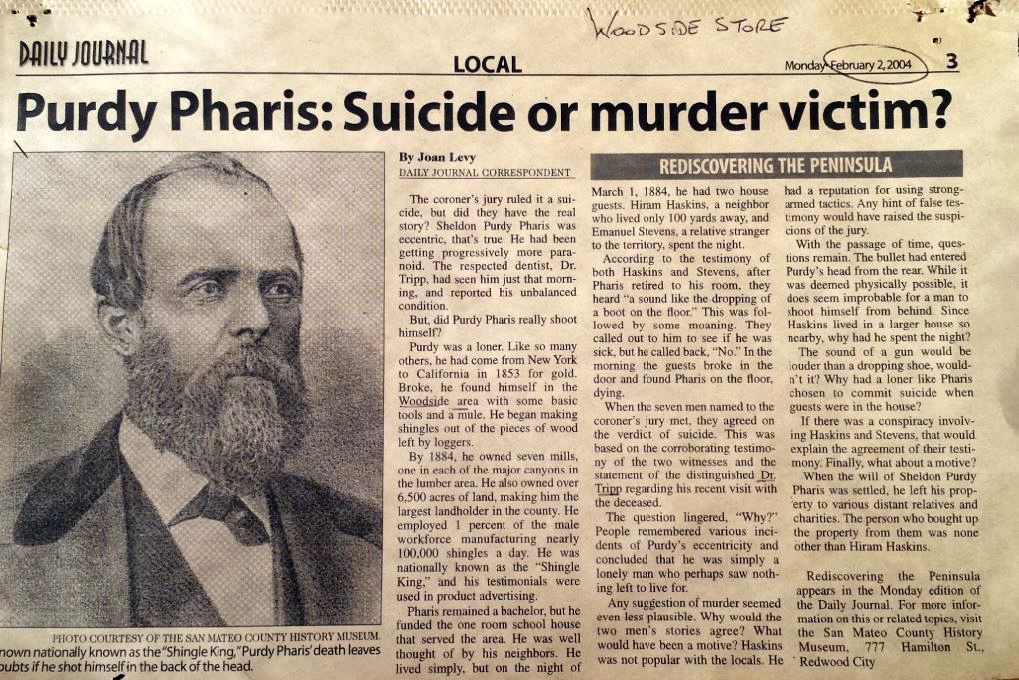
A full Account of the Recent Death of Sheldon P. Pharis -
Statements of Witnesses -
The Funeral
On Saturday morning last, news was brought to town that
S. P. Pharis, an old and highly respected citizen of
this county, had committed suicide
at his residence on the mountains some
three of four miles beyond Summit
Springs. At first it was rumored that
he was dangerously wounded, but
later reports confirmed the statement
that Mr. Pharis was dead. As soon
as was possible Coroner Loveland repaired
to the scene of the death,
and hastily summoned a jury composed
of the following named citizens, all of
whom are residents in that neighborhood
and personal acquaintances of
the deceased: Alfred Brackett, Alfred Fay,
W. W. Durham, Alexander Monroe, John Shutts,
David H. Muny, Frank C. Gilbert.
The only witnesses that were examined at the inquest were
Hiram D. Haskins and Emanuel Stephens.
Mr. Haskins has for some years past
been a near neighbor to Mr. Pharis, and
Mr. Stephens was an old friend,
and at the time of the suicide
was visiting the deceased.
From the testimony given by these
two men at the inquest, and what has
been observed by those who had
been intimately acquainted with Mr. Pharis,
there is no reason to doubt
that at the time of his death and some
previous thereto, he was bordering on insanity.
Dr. R. O. Tripp, of Woodside, was
interviewed by a GAZETTE reporter,
and he tells of what transpired between
himself and Mr. Pharis on the
day before the act was committed.
Hiram Haskins came to Woodside,
sought Dr. Tripp, and informed him
that Purdy was acting in a very
strange manner, and that as he (Tripp)
was an old acquaintance of Mr. Pharis,
he might be able to do something for
him. Dr. Tripp tried to induce Mr.
Pharis to come to Redwood and consult
a physician, knowing him to be suffering
for some time past with
neuralgia, and to that ailment he
attributed his mystterious actions. After
many fruitless efforts to gain his point,
Dr. Tripp finally abandoned the
scheme. He talked to Mr. Pharis,
endeavored to calm him, and having
succeeded, as he supposed, he departed
for his home. The next morning he
heard of Mr. Pharis' death. From the
statements of Mr. Haskins and Mr. Stevens
the following facts are allotted:
Mr. Pharis had been acting in a
strange manner for about a month,
and his actions were such as to show that
his mind was to some extent impaired. In his
converstion he would repeat his questions
a number of times, and quite
often could not be induced to talk at
all. At one time he told Haskins that
he (Pharis) was going to pieces, and
that was the reason why he did not
like to be left alone. He imagined
that people were watching him; that
the editors of the Redwood City newspapers
were publishing articles about
him, although they did not use his
name, but their object was to damage
his character. He could not sleep and
would spend the night talking to himself.
On the evening prior to his death,
both Mr. Haskins and Mr. Stevens say that
Mr. Pharis retired in apparently
a better state of mind than usual.
Mr. Pharis' house is so situated that
from the rooms occupied by the two witnesses
anything might easily be heard that
transpired in that which
the deceased slept. During the fore
part of the evening in question the
two men heard noises in the other
part of the building. This noise they
supposed to be caused by the dropping
of a boot. They heard Mr. Pharis
groaning, and when asked if he was
ill, he replied that he was not. Nothing more
was noticed of the deceased
until the next morning. At about
5:30 o'clock Mr. Haskins arose, dressed
himself and began to make preparations
for breakfast. Shortly after Mr. Stevens
arose. While the two men were together they heard
groans, of sounds similar to one snoring, or
breathing in a distressed manner in
Pharis' room. The door was burst open
and Mr. Pharis was discovered lying on the floor
with his feet slighly
drawn up. An examination disclosed
a wound on top of his head, and a pistol
lying close by. He was then in a dying
condition. They being all the
witnesses to be examined the evidence
then closed, and the jury brought in a verdict
that the deceased, Sheldon P. Pharis, came
to his death from a pistol shot wound,
fired by his own hand,
and that the deed was done with suicidal intent.
The remains were then conveyed to
Redwood and deposited in James Crowe's
undertaking establishment.
The death of S. P. Pharis has cast a
gloom over the entire county. And
expressions of sadness are everywhere noticeable.
He is said by some to have been a man of a close and
grasping disposition, which story is quickly
set aside when one takes into consideration
his many acts of charity, public
beneficence, and personal favors. He
was endowed with a kind heart, and a
generous nature. In cases of need Mr.
Pharis always responded heartily.
One instance remarkable of his
public spirit, which will over remain a monument to his
generosity, was the building of the
Pharis District school house, which Mr. Pharis
had erected at his own expense, completed
with a neat tower, in which
was hung a splendid bell, making the building,
though small, one of the
nicest in the county. Mr. Pharis,
of course possessed the usual characteristics
of a man controlling a large
business, he was shrewd and careful
in all his dealings. Suffice it to say that
he was honest - strictly honest, and more than
that can be said of no man.
Sheldon Purdy Pharis was a native of
Geddes, Onondagan County, New York.
He was unmarried and at the
time of his death was aged about 56
years. He was extensively engaged
in the shingle business, and owned two large
mills, thereby giving employment to a great
many men, among whom, as well as all with whom he
had dealings, he had gained a reputation
of which one might be envied.
The funeral occurred on Sunday afternoon
at 2 o'clock, the day following his death,
at the Congregational Church. This large
edifice was completely thronged with people.
At the conclusion of the services, which were
conducted by Rev. R. H. Sink, all that was
mortal of S. P. Pharis was conveyed
to its final resting place -- Union Cemetery.
Judging from the number of carriages
that followed the remains to the graveyard one
could easily see that there was no lack
of sympathy expressed, and the high
regard in which the deceased was held was fully
exemplified. Appended is the sermon in full,
as delivered by Mr. Sink.
...
Our gleanings of facts have been meager. We collate
and give them as follows:
Sheldon Purdy Pharis, at the time of his death,
56 years of age, was borne in Onondagan Co., New York,
March 22, 1829. He was educated at
Syracuse , ____ State. He received the substantial
training of the farm where he was brought up. He came
in 1858, by the way of Panama, and landed on
this Coast four years after the great
excitement, which had not subsided then.
He engaged in mining a few months, but
finding poor encouragement, he came
to this county, located on the mountains, which had
been his home ever since - 30 years. He heart,
was tender. Tho needs and sufferings of humanity appealed strongly
to his sympath__ which he manifested by help
and aid. His feelings did no evanesce in sentiment; he rendered
assistance when he felt it was needed. No one
destitute called upon him in vain.
His patriotic and public spirit - constant.
His dealings - honorable. His debts he paid
in full. His business relations
with Hanson & Co., for over 23 years we always
characterized by truth, honesty, honor. The little and trifling
trickeries so prevalent among the acts of a
multitude were beneath him. His habits - temperate.
He was a man, either fortunately endowed by nature or one who had a
marvelous self-government. Few unbound of every social
tie, cut loose from the restraints of the home
circle would thus, in the dignity of their manhood,
single handed fight tho temptations, and escape
the machination of the )______ of society, and ..
___ the pit-fallslying all along the pathway, especially of
pioneer life. There is this in the history of the one
we have bet to pay our last respects to today,
that is worthy the immitation of all, especially
young men....
Taciturn, except in business. Was nebver married,
leaves no relatives in this
State but one brother, two sisters in the East.
His death was a sudden and severe shock to his friends, of whom,
the number was almost unlimited.
'Twould be a misnomer to call him a suicide,
for we are persuaded that his death
was occasioned by the wild freak of a
disordered brain. The cause for the
dethronement of his reason may never
be known. Gradually, for some time,
has his mind been giving way. Did he
become rational enough to realize the ...
Disordered reason pictured for our departed
friend a scene of isolation; it deprived him of
family and friends. What would be the happy
emotions could he now with sound mind gaze
upon the scene? Wandering reasonmay have bereft
him of friends, yet friends he had, for the best
testimony of esteem is such silent though eloquent tribute as you
may now offer. Though no tender relative
is here to-day to weep over his cold
remains, that office without __________ is
performed by those who not only weep with
but for those that weep. Was he esteemed? Look at
this assembly, feel th throbs, notice the
falling tears. A scene to soften the stony heart
of the misanthrop. But let not your tenderness
end here; turn from the dead to the living; show kindness
and charity to those about you...
|